Ron Morris
Xin Xiang, Berl Oakley, Claudio Scazzocchio and Miguel A. Peñalva
Ron Morris (N. Ronald Morris) passed away at home on November 20, 2025, at the age of 92. Ron was a first-class scientist who understood, very early on, that mutant screens in Aspergillus nidulans could illuminate fundamental problems of cell biology and devoted himself to apply this approach in his landmark studies on the cytoskeleton, mitosis and nuclear distribution. His group identified the first alpha- and beta-tubulin genes, which paved the way for the identification, a few years later, of gamma-tubulin (Oakley, B.R. (2023). The ring saga: looking back at the discovery of gamma-tubulin and gamma-tubulin ring complexes. Mol Biol Cell 34, rt1). His lab demonstrated that nuclear movement is microtubule-mediated. His was the idea of using tubulin mutants to show that the effects of benomyl were specifically on microtubules and not some other, unknown, site of action. In his seminal 1975 paper (Morris, N.R. (1975) Mitotic mutants of Aspergillus nidulans. Genetical Research 26, 237-254) Ron reported the identification of key mitotic and nuclear distribution genes using temperature-sensitive alleles, including the nim (“never in mitosis”) mutants blocked in G2, the bim (“blocked in mitosis”) mutants arrested in M phase, and the nud (“nuclear distribution”) mutants defective in nuclear migration. Building on bim and nim mutations isolated in this screen he developed molecular technology that led to the characterization of the first mitotic motor, BimC, the founding member of the kinesin-5 family, which drives the elongation of the mitotic spindle, of the NimA kinase, which cooperates with Paul Nurse’s. cyclin-dependent kinase Cdc2NimX to promote the transit from G2 to mitosis, of the anaphase-promoting complex components, BimE and BimA, and of the BimG phosphatase mediating mitotic exit to quote a few examples (Osmani, S.A., and Mirabito, P.M. (2004). The early impact of genetics on our understanding of cell cycle regulation in Aspergillus nidulans. Fungal Genet Biol 41, 401-410). As for the nud genes, Ron’s lab characterized nudA as the gene encoding cytoplasmic dynein, the genes encoding the universally conserved dynein regulators nudF, encoding the lissencephaly protein LIS1, and nudE, encoding another key dynein regulator.
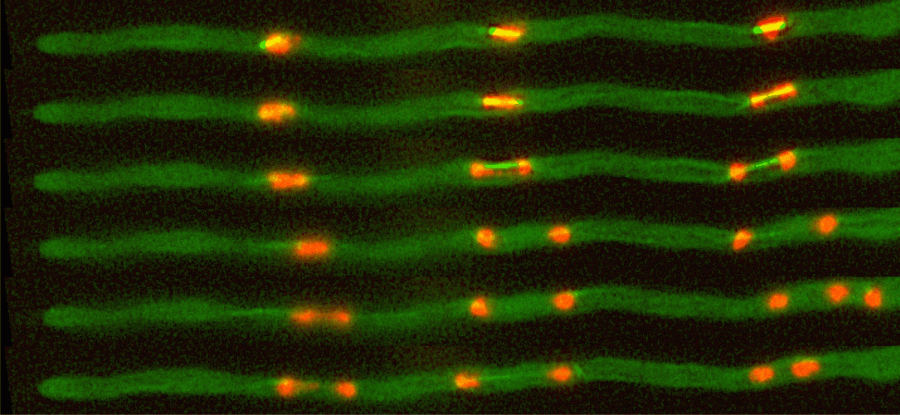
As overwhelming that this impressive record of publications may seem, his scientific legacy goes far beyond these appealing contributions. Among the “less popular” (yet very highly cited) contributions outside the field of mitosis and microtubules is the characterization, in the late 1960s, of the dam methylase of Escherichia coli, which is critical for mismatch repair and the control of DNA replication. Ron was also very proud of his paper on the characterization of the nucleosomal repeat in Aspergillus nidulans, demonstrating that the length of DNA protected by the nucleosome core (hence, the size of the nucleosome itself) was conserved between Aspergillus and rodents.
Ron was not only a first-class scientist, he was also a superb mentor, with some of his students and post-docs now leading excellent research teams. Ron’s contributions to science—and to the cell biology and fungal genetics communities—were profound and lasting, but his legacy went far beyond that. He was the opposite of a narrow, blinkered scientist, having wide artistic interests and humanistic concerns. His deep intelligence and characteristic sense of fun made interacting with a him a most rewarding experience. He will be deeply missed.
 European Conferences on Fungal Genetics
Leave a comment